
Swagger: What Broke, What Worked, What’s Left
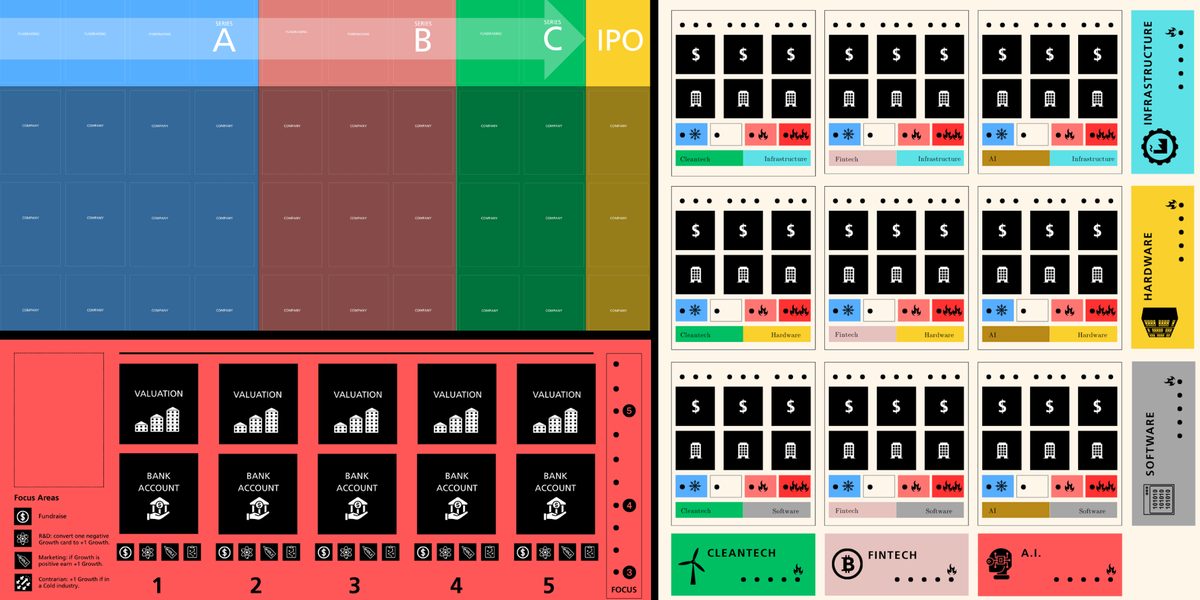
Over the last six months there has been a lot of progress with Swagger, but not many updates on the blog. This post covers some of the 10+ versions that have been created and tested during this time.
Designing a board game keeps teaching me the value of craft. It's not enough to have one good idea or to invent a really cool feature. What matters is how everything comes together to create something that is more than the sum of its parts.
Swagger has never been closer to achieving this. I've seen glimpses of this 'magic' when people play.
Design iterations
Version 9.x tested a lot of novel concepts including World Events, founder traits, industry momentum, Clout/focus, coop and competitive play. I brought in a game board (vs just cards), then removed it. I just added it back in.
Players immediately understand runway and the need to hoard dry powder. They instinctively understand the tension between investing enough cash to allow companies to breakthrough, and saving enough for later. They let laggards die and they push winners. This is a key learning outcome of the game, but managing money is also fun.
Industries were the next breakthrough. Instead of random world events, I tried making fundraising cause industries to heat up. Enough activity and an industry becomes hot. Suddenly players care what everyone else is funding.
It worked but it also became very fussy to track. Tracking heat started to feel like bookkeeping.
Clout evolved the same way. It started as reputation, something very important to being an investor. But it became too many things. Now it’s Focus. You have limited attention each turn. You can invest, optimize growth, or use special skills. That constraint finally made the game feel like being a VC. You can’t be everywhere.
One of my favorite changes was splitting growth into different decks. Default growth is mediocre. Focused growth is steadier. Aggressive growth has upside but real downside. This achieves the right balance between uncertainty and player agency. I want the results of the game to be about your choices, not just a dice roll.
Investing is also treated the same way. To invest you still have to negotiate with the founder and there is a chance they'll turn you down. It's not automatic.
The IPO math took a while. Multiples, modifiers, sentiment tracks. In the end the cleanest version is equity squared. Fifteen equity at IPO becomes $225M. It’s dramatic and intuitive. When someone rings the bell and pulls in a huge return, everyone gets it.
This also makes equity intuitively valuable. Since each equity chip adds a 1x multiple to an exit, it is extremely valuable. The bigger the equity stack the higher the multiple. This is elegant without requiring boring cap table math (which I tried).
Coinvestment is still the hardest thing to get perfect, but it’s essential to venture capital. It creates negotiation and tension. But it’s messy to track. In the latest version I've added some rules and incentives to make coinvesting more attractive.
There are limited player vs player mechanics including the ability to distract other players and cause them to lose Focus. Some players don't like the backstabbing. Others, especially VCs who've playtested it, love it. No comment.
Balancing
The biggest tension I keep running into is this: the more accurate the simulation, the less fun it sometimes becomes. Workshops exposed that brutally. People don’t want to manage fifteen trackers. They want to feel the pressure and make strategic decisions, not do bookkeeping.
Some versions were more “correct” but less alive. The recent versions are drifting back toward surprise. More cards. More player interaction. More risk. A little more chaos. More table talk.
What I care about now isn’t whether every mechanic mirrors real VC perfectly. It’s whether players walk away understanding how the VC game is played.
We're currently playtesting the latest version. If you are interested, and can assemble a group of 4 players, reach out and we may be able to send you a copy.